Sapna aapka, Mehnat hamari

Earthquake Resistant House Construction in Uttar Pradesh
Is your home in UP built to survive an earthquake? Most are not. Here is what earthquake resistant house construction in Uttar Pradesh actually means and why it matters more than you think
4/28/20265 min read
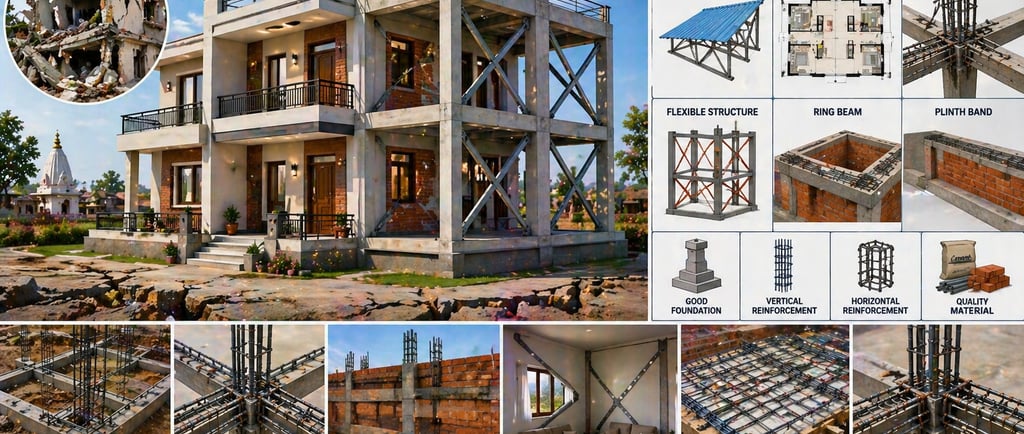
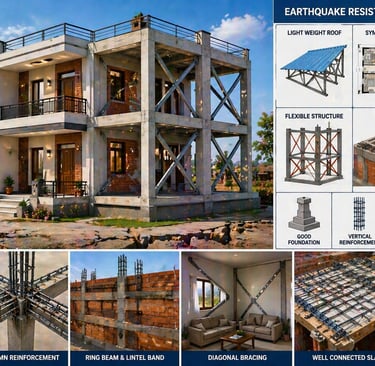
Is Your Home in Uttar Pradesh Built to Survive an Earthquake?
Nobody wants to think about this question.
We spend months planning our dream home choosing tiles, debating wall colours, arguing about whether the kitchen should face east or west and almost nobody asks the one question that matters most of all.
If the ground shakes, will my home hold?
In Uttar Pradesh, that question is not hypothetical. Varanasi, Prayagraj, Gorakhpur, Lucknow, and most of eastern UP sit inside Seismic Zone III - a classification by the Bureau of Indian Standards that means these areas face a moderate-to-high risk of earthquake activity. Yet the overwhelming majority of homes being built in UP today are not constructed with seismic safety as a deliberate design priority.
This blog is not meant to scare you. It is meant to inform you before you build, not after.
What Seismic Zone III Actually Means for Your Home
India is divided into four seismic zones based on earthquake risk - Zone II being the lowest and Zone V being the highest. Uttar Pradesh falls almost entirely within Zone III, with some northern parts near the Himalayan foothills touching Zone IV.
Zone III means that your region can experience earthquakes that are strong enough to cause serious damage to poorly built structures particularly those made with weak concrete, under-reinforced steel, or without any seismic design consideration.
Here is what that means in plain language. A home built with proper seismic precautions will shake during an earthquake and remain standing. A home built without those precautions even if it looks perfectly strong from the outside may crack, partially collapse, or in the worst case, fail completely.
The difference between the two is not the cost of the land. It is not the size of the budget. It is entirely in the quality of structural design and the materials used during construction.
The Three Things That Make a Home Earthquake Resistant
You do not need to be a structural engineer to understand this. There are three fundamental things that determine whether your home in UP will hold up in a seismic event or not.
1. The Foundation
Everything starts here. Soil testing is a crucial step that is often skipped by homeowners in India. It involves analysing the soil composition and density at your specific construction site. This testing tells your structural engineer whether the ground beneath your home is stable enough to carry the load and what kind of foundation is needed for seismic safety.
In Varanasi and surrounding areas of eastern UP, soil conditions vary significantly depending on how close you are to the Ganges river belt. Sandy, loose soil near flood plains requires a very different foundation than the harder soil found in areas further from the river. Without testing, your contractor is essentially guessing.
And when an earthquake comes, guesses are not good enough.
2. The Steel Inside Your Walls
In earthquake-prone zones, ductility becomes critical. Steel must be able to bend slightly without breaking under seismic stress. This is why earthquake resistant house construction in Uttar Pradesh requires Fe500D grade TMT bars — the "D" standing for ductile. These bars are specifically manufactured to flex under stress rather than snap.
Many contractors in UP use cheaper, lower-grade steel to cut costs. It looks identical to the right material from the outside. You cannot tell the difference by looking at it. But in a strong earthquake, that difference becomes the difference between a home that bends and holds and one that does not.
Always ask your contractor to show you the ISI certification and mill test reports for every batch of steel that arrives on your site. A trustworthy contractor will have no problem showing you this.
3. The Concrete Mix and Curing
Weak concrete is a silent killer in earthquake-prone areas. The strength of your RCC columns, beams, and slabs depends entirely on two things - the correct water-to-cement ratio during mixing, and proper curing after pouring.
We have already written about curing in our tips series - the practice of keeping freshly poured concrete wet for a minimum of seven days so it achieves its intended strength. Skipping curing does not just risk hairline cracks later. In seismic events, under-cured concrete behaves in the worst possible way.
A column that was poorly cured will not give you a warning. It will not crack slowly. It will simply not perform when the load demands it.
What Most Contractors in Varanasi Do Not Tell You
Here is the uncomfortable truth about construction in UP right now.
Building code compliance including seismic design standards is mandatory on paper. The BIS codes for earthquake resistant construction are clear, detailed, and updated. But enforcement at the residential construction level, particularly for individual homeowners building their own homes is almost nonexistent.
This means the responsibility falls entirely on you as the homeowner and on the contractor you choose.
As a homeowner, demand compliance. It is your right. Ask your contractor whether the structural design accounts for seismic Zone III requirements. Ask whether the column spacing, beam depths, and reinforcement ratios follow IS 1893 guidelines. Ask for a structural drawing signed by a qualified engineer, not just an architect's elevation sketch.
If your contractor cannot answer these questions, or dismisses them as unnecessary for a "simple residential project" - that is important information. A home in Zone III is never a project where seismic safety is optional.
Simple Steps You Can Take Before Construction Begins
This does not need to be overwhelming. Here are four practical things every homeowner in UP should do before the first brick is laid.
Get a soil test done. It costs between ₹3,000 and ₹8,000 depending on your location and the depth of testing required. For a home that costs ₹20–50 lakh to build that is the cheapest insurance you will ever buy.
Ask for a structural engineer on your project. An architect designs how your home looks. A structural engineer designs how it survives. Both are necessary. Many homeowners in Varanasi hire one without the other. Do not make that mistake.
Verify your steel grade. Ask to see the ISI mark and mill certificate for every batch of TMT steel used in your columns and beams. Fe500D is the minimum for seismic Zone III. If your contractor uses anything less - push back.
Do not skip curing. Every column, beam, and slab should be cured with water for a minimum of seven days after casting. Put this in your contract. No exceptions, no compromises.
A Final Thought
We build homes to last generations. Your children will grow up in this house. Your grandchildren may play in this courtyard. The walls you build today are not just shelter for this year, they are the structure within which your family's life will unfold for decades.
Earthquake resistant house construction in Uttar Pradesh is not about fear. It is about respect for the lives that will be lived inside those walls.
Build it right. Build it once.
At P.C.C. Group, structural integrity is not a checkbox on our list. It is the foundation of everything we do before the first column is cast and long after the final coat of paint dries. If you are planning to build in Varanasi or anywhere across UP, come speak with our team. We will walk you through exactly how we build for safety and show you the difference it makes
Contact
Reach out for your dream project.
constructionpandey92@gmail.com
© 2026. All rights reserved.
address
Near Versova Hospital, Sangam Vihar Colony, Awaleshpur, Varanasi-221106


P.C.C. Group is a trusted construction and design company in Varanasi, offering complete solutions from 2D/3D planning to final building execution.
They focus on quality, modern design, and timely delivery to turn your dream home into reality.
Our Services
Renovation & Remodeling
+91 8840521602, 9125850489